Google Working On Cookie Alternative Posted: 19 Sep 2013 04:19 AM PDT Google is working on an alternative ad tracking system that could potentially replace cookies. Cookies are used by advertisers and web sites to track your web history, so that they can tailor adverts based on your possible shopping interests. Google is working on a system called “AdID”, which would allow them to abandon the cookie system completely. It is currently the only browser that allows all cookies as the default setting. Rival companies to Google’s Chrome have all taken a stand against cookies, with Microsoft’s default setting in Internet Explorer being “do not track” and Apple’s Safari browser blocking third-party cookies altogether. For browser makers, maintaing a robust cookie environment offers little financial reward, whereas keeping users happy yields better financial incentives. If Google can prove that its new AdID system is more useful for advertisers and more private for users than cookies, then Google could be on to a winner. Apple has its own cookie alternative called the “identifier for advertisers” or IDFA. AdID could be the thing that helps Google compete not just with Apple but with all its rivals. |
Valve Launches Steam Family Sharing Posted: 19 Sep 2013 03:30 AM PDT The family that games together…stays together? Have fun together? Engage in massive competition against each other, for sure. If your household is into gaming, and you use Steam heavily, then you will be happy to know that Valve is launching family sharing for the platform. Sharing is always a good thing, especially when it comes to gaming and accounts, and Valve’s Steam Family Sharing is certainly going to make a lot of people happy. With the capability of sharing game libraries with other accounts on up to 10 devices, there is a lot to look forward to. If, for example, you share a gaming computer at home, you can also benefit from Steam Family Sharing. Using that authorized computer, individual members of the family can play their games all the while making sure that the game saves and achievements are attributed to the proper account – all thanks to the Steam cloud. Now, if you have a tendency to snoop, and you see that someone in the family has already downloaded a game that you want to play, you can also request access via Steam Family Sharing. All that family member has to do is to authorize your computer to gain access to the game in question. There are limitations worth taking note of, though. One, not all Steam games will be available for sharing. Two, rather obviously, only one person can play a shared game at a time. If a game is currently in use on another computer, and you want to play, the borrower will be given time to quit the game. Right now, Steam Family Sharing is still not out, but in the very near future (they say mid-September, though we’re slightly past that point), Valve will start the private beta. There’s no need for me to point out that you should (try to) sign up for that beta NOW, is there? |
Big Screen Gaming From Tiny GameStick Console Posted: 19 Sep 2013 02:34 AM PDT The GameStick console will be the latest release from PlayJam, the UK based interactive casual games network. The tiny 2 inch console is part of PlayJam's vision to provide easy big screen gaming solutions for the whole family at affordable prices. GameStick is an easy to use, highly portable plug and play console that allows users to bring their games directly to the big screen. How it Works The GameStick console will plug straight into a free HDMI port on the TV, powering up from the Mobile High-Definition Link (MHL) if there is one. If another powers source is needed, there's a power adapter and micros USB port on the stick. The controller connects to the stick via Bluetooth. Specs:
Healthy competition between console manufacturers is good for everyone. GameStick is being compared by many to the Ouya games console which was released in June 2013. Both consoles have backers on Kickstart and both had similar release dates at first. In an interview with Gamasutra, PlayJam's CEO Jasper Smith says this about being second to release the product: "There's a lot to be said for letting others go first and learning from it" How To Get A GameStick Anyone who loves the idea of this microconsole can get their hands on one from the 29th Octobeer 2013 from Amazon or Gamestop for a very affordable $80. Included with each package as standard is:
|
Mercedes Benz Self-Driving Car Makes Cross Country Trip Posted: 18 Sep 2013 11:05 PM PDT At the Frankfurt Motor Show (Sep 10-22) onlookers were told by several auto giants that the birth of fully autonomous cars was going to be soon. A mere 7 years in fact. What better to prove this theory than an announcement that the Mercedes Benz self-driving car had actually completed its first ever cross country trip without any help from a driver at all. Out On The Open Road Mercedes Benz S500 Intelligent Drive drove through Germany from Mannheim to Pforzheim, which is approximately 100km. During the drive the autonomous car negotiated roundabouts traffic lights and jams and pedestrians comfortably on its trip. The success of this test compared to other manufacturer's autonomous tests is all the more impressive due to the fact that the self-driving car negotiated its way through roads that were open to the public. Mercedes was able to get a clear picture of how the car would cope in the real world. Other tests that have been completed in the past have been in controlled environments on closed roads. Futuristic Technology? Perhaps the most surprising nugget of knowledge is the fact that Mercedes say the technology used in the S500 Intelligent Drive is not a far cry from the technology seen in the current S-Class. Partial self-driving technology is already out there with the likes of lane control etc. however drivers are still required to have control of the car. Hands must be left on the wheel at all times or full control of the car is returned to the driver. In the future, the driver won't have to pay attention at all but be available in case of emergencies. So you can read behind the wheel but you won't be able to nod off. According to Mercedes, Nissan and other companies, this technology should be available in 2020. In fact, the Mercedes Benz self-driving car is the closest anyone has actually got to the dream of autonomous cars. Mercedes say they could have released the finished product at the end of next year but the question of whether the technology could cover all eventualities and prevent accidents stopped them short. Then there is the future of self-driving cars; Google wizards have been focusing on producing their own self-driving vehicles with a view to using them in a robo-taxi service. These cars will need no driver at all and be fully autonomous. What will the roads look like with driver-less cars? |
Showing posts with label Google Console. Show all posts
Saturday, 28 September 2013
Google Working On Cookie Alternative
Monday, 22 July 2013
QR Code Hacks Google Glass
Posted: 21 Jul 2013 07:00 AM PDT Another security weakness has been found with Google Glass. Using a QR code, security analysts at Lookout were able to force the Glass device to perform certain actions, such as sharing a user's screen or joining wireless networks, without the user’s knowledge. Google Glass is set to automatically process any QR code that the device's camera detects; this is to help achieve the minimalistic design and interface. The moment Glass recognizes the command that the QR code contains, Glass executes it. All a hacker has to do is create malicious QR codes that commands Glass to do any number of actions. This is where Lookout created a QR code that forced Glass to initiate a Glass-cast, which is what a Google Glass user can see with a device connected via Bluetooth, without the user knowing. Theoretically, this could allow a hacker to completely spy on everything someone sees, including personal information and data, such as an ATM PIN or another secure data password. Lookout pointed out to PC Mag that this is not too threatening as it first appears to be, as a hacker would need physical access to a pair of Google Glass in order to pair a device with Bluetooth. The hacker would also have remain pretty close to the user to keep getting the feed. The QR code designed to force Glass to connect to Wi-Fi network, however, is a much more troubling problem. A hacker could monitor everything a user does with Glass while connected that network or even hack the device completely. For those of you unfamiliar with QR codes, they are those squares with black pixels that can be scanned with a smartphone or similar device. These are becoming more and more common on advertisements. A hacker could create one, print and copy it and post the copies anywhere. Someone could easily be tricked into scanning the code and giving up control of their Glass. Finding security issues has been an important part of the Explorer Edition of Google Glass and Google has been quick to fix these issues. In other news; another hacker successfully jail broke Google Glass a few months ago in May and pointed out some very serious security flaws that Google was able to address. Just two weeks after Lookout presented this QR code vulnerability to Google, the company updated Glass to prevent the device from automatically executing a command. Still, Google did not see QR codes as a potential avenue for an attack. Users should only scan a code if they know what it is going to do, right? Try telling the auto feature of QR scanning in Glass that! |
Rumour: Apple In Talks to Buy Xbox Kinect Sensor Company Primesense Posted: 21 Jul 2013 03:00 AM PDT Industry leader Apple is reportedly looking to acquire the Israeli fabless semiconductor company Primesense. According to local newspaper Calcalist, the Cupertino company has made an offer around the $280 million mark, to buy the company responsible for the 3D sensor found in Microsoft’s Kinect devices, following discussions over the embedding of its technology inside future Apple products. In the past, Primsense worked with Microsoft to include its technology, chips, and designs inside the first Kinect accessory for the Xbox 360 games console. Primesense’s 3D-scanning technology is used in more than 20 million devices around the world, including sensors that can be used in both smartphones and tablets. Primesense technology can also be found in new portable scanners which are capable of generating finely detailed color 3D models of interior spaces. This is not the first time Apple has looked to purchasing an Israeli component maker. Back in January 2012, the company confirmed it had acquired the flash storage company Anobit in a deal worth in the region of $400 Million. While Primesense in the past, has been focused on the gaming world and what it encompasses i.e. technology surrounding the gaming environment, the company’s more recent projects include working with technology forerunners ASUS to provide the 3D sensing technology for its WAVI Xtion PC which allows you to enjoy PC content on the big screen with a wave of your hands through the Xition Portal, for intuitive entertainment in the living room. The future development of 3D motion-activated games are also rumoured and the company has also collaborated with various companies in the retail field as well as various industries in the fields of robotics and healthcare. |
Saturday, 20 July 2013
Google Releases OEM Patch For Major Android Security Flaw
Posted: 15 Jul 2013 08:00 AM PDT eBay has joined the craze for 3D printing after announcing the debut of a new iPhone app app called eBay Exact. Users are able to search through and buy customizable print-on-demand products from 3D printing companies MakerBot, Sculpteo and Hot Pop Factory. It is hoped this stand alone application will make it easier to find 3D printed items. So far there are 20 categories to browse through, with products mainly like jewellery and iPhone cases. The chosen product can be configured and then ordered all thorugh the mobile app, then shipped directly to the customer within 7 to 14 days. Ebay are not the only company promoting 3D printed goods. Staples announced in May that it would start selling 3D printers and Amazon now has its own 3D printing store. However consumers appear to still prefer to shop at sites like Shapeways, who have become an important role in making 3D printed goods more accessible to the general public. The site allows users to buy available print-on-demand goods or for those with a flair for design, turn their own ideas into products. Whether people will start turning to eBay for 3D printed products will show over time. Vice President of Innovation and New Ventures for eBay, Steve Yankovich said, “Shoppers today not only want to buy items anytime, anywhere through mobile devices, but they also want to be able to personalize their purchases”. But with this market still being relatively new, it may take time for consumers to become aware of the possibilites. |
Google Releases OEM Patch For Major Android Security Flaw Posted: 15 Jul 2013 07:00 AM PDT In a follow up to our recent report regarding how an Android Security Bug was found to let hackers gain system access, Google has released a fix to its Android original equipment manufacturers (OEM’s) for this bug, named: Android security bug 8219321 as unearthed by Bluebox Security in February this year. The flaw was confirmed from Google's Android Communications Manager, Gina Scigliano, she said "a patch has been provided to our partners." She also mentioned "Some OEMs, like Samsung, are already shipping the fix to the Android devices." The flaw in question will allow a hacker to turn a legitimate app into malicious files by modifying APK code without breaking the app's cryptographic signature. In response to this, Google has already modified its Play Store's app entry process to scan for the exploit so apps that have been modified using this vulnerability can no longer be distributed via the Play Store. Bluebox Security discovered the hole in Android's code, which it claims could potentially affect 99 percent of Android devices, back in February and informed Google at that time. (but only made it public recently). Samsung's Galaxy S4 was named then as one Android device that had already been patched, so it seems likely that this model is the device Gina Scigliano referred to when she cited Samsung as a manufacturer already shipping a fix. The problem for Android users is that even though Google has now in fact released a fix to its OEMs, they still have to wait for the maker of their particular handset to implement and ship the fix. This also poses another question, how long before their particular carrier tests it? Having to wait around to receive updates is a byproduct of the freeness and fragmentation of the Android sphere, still, it does not sound like this particular Android flaw has been widely exploited thus far. Scigliano has told ZDNet: "We have not seen any evidence of exploitation in Google Play or other app stores via our security scanning tools. Google Play scans for this issue and Verify Apps provides protection for Android users who download apps to their devices outside of Play." But just because it has not been widely exploited yet, does not mean it will not be…does it? |
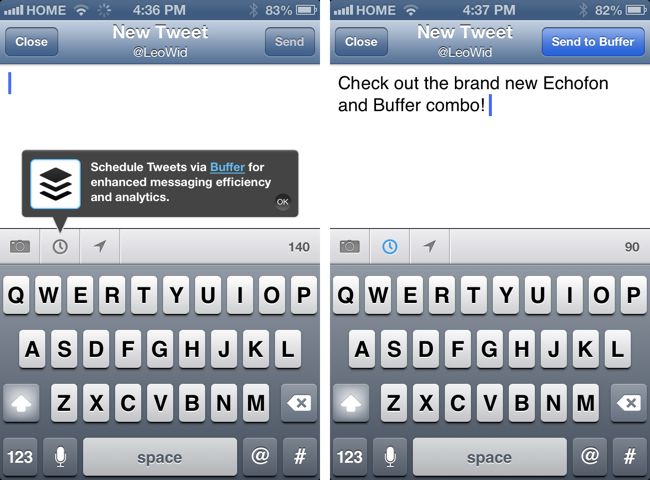
Buffer & Echofon Partner Up to Make Your Life Easier Posted: 15 Jul 2013 06:00 AM PDT There are countless tools online that you can use to make your life easier, especially if you are a social media professional. Every pro has his own particular favorite, but for those who have interacted with me, it is no secret that I love Buffer. What started out as a small startup – the founders even had problems with US visas in the beginning! – is now one of the most popular and most useful social media tools out there. For scheduling and spacing out tweets (and other social media posts) – Buffer is the way to go. Now, Echofon has a little more on Buffer in terms of age, being one of the popular Twitter clients in existence. I use a different client for my needs, but Echofon certainly has more than its fair share of followers. Put together these two entities, and what do you have? A pretty neat experience for users. In a blog post published last week, Buffer co-founder Leo Widrich announced the partnership between Buffer and Echofon. If you’ve been using the scheduling tool for a while, you’ll know that they have cemented partnerships with other entities – Twitter clients, browsers, etc. – which is the logical thing to do. With this Buffer and Echofon hook up, though, more users are able to schedule their posts on the go. Echofon is available both for iOS and Android, and the new integration with Buffer is not limited to one platform; so, yay for everyone! If you’re an Echofon user, but you’ve never tried Buffer out, you really ought to give it a shot. You can thank me later. On the other hand, if you know what Buffer is all about but use another Twitter client, does this integration tempt you to switch to Echofon? I’m a Tweetbot fan, but I have to admit I am thinking of downloading Echofon… |
PS4 Can Alter Gaming Landscape, Sony Says Posted: 15 Jul 2013 05:00 AM PDT Okay, we all know by now that Sony's PlayStation 4 is likely to be a very big hit and probably outsell Microsoft's Xbox One, but there's no need to rub it in. Sony doesn't seem to have any intention of halting its "charm offensive": the new gaming platform's architect, Mark Cerny, recently said the upcoming PS4 has the potential to significantly alter the landscape of gaming. So how's that for raising the bar? PS4 architect Mark Cerny says the next system can alter the landscape of gaming. And if that isn't enough, the PS4 is now touted to mark a renaissance of gaming, according to Cerny. The new system's lead architect also insisted that the console has the potential to have the highest variety of content and richness of material. Cerny talked about the flexibility of the new console and insisted that the next-generation system can give game developers and Sony more customization than a PC. He underlined that the PS4 will have an architecture that will be more accessible to independent game developers and make it easier for them to develop and self-publish their titles. Sony has already announced an impressive line-up of independently developed games for the new console, along with policies aimed at helping independent developers publish and promote their own titles, as part of the company's declared intention to focus more on consumers and developers. On their end, Microsoft officials say the Xbox One is the future of gaming and entertainment and will allow users to switch between experiences in a unique way, making the new system the best place to play games for many years to come. After backtracking on its DRM policies, the company has seen a marked increase in sales for its new consoles. It remains to be seen how the Microsoft-Sony competition will play out after gaming fans actually get the opportunity to try the two consoles for themselves. Both will feature at the GameStop Expo on August 28 in Las Vegas. Before that however, the PlayStation 4 and the Xbox One will be playable at Comic-Con in San Diego this weekend. The Xbox One will be released in November. Sony has yet to specify an exact date for the PlayStation 4 launch, but gave assurances that it will definitely happen before Christmas. PS4 architect Mark Cerny says the next system can alter the landscape of gaming. |
Bukito: The Fast, Travel-Friendly Portable 3D Printer Posted: 15 Jul 2013 04:00 AM PDT Most of the 3D printers currently on the market are bulky, hard to carry around and rather slow. So it's pretty hard to imagine one of these gadgets being able to continue printing upside down or in flight. But the Bukito, from Deezmaker, can do all this and more: this portable 3D printer is sturdy, fast, very light and affordable, making it a promising addition to the personal-use 3D printing market. The Bukito portable 3D printer weighs only six pounds and has a printable area of 5 x 6 x 5 inches. The device is equipped with sturdy aluminum rails, which make for a very stable printing platform. Due to this fact, the device is able to continue printing even when carried around or turned upside down. Deezmaker president Diego Porqueras said the printer was specifically designed to be lightweight and stable and therefore appropriate for travel. The device will be ideal for classroom use and can be easily shared between teachers or students, he explained. Its rigid construction and the lightweight extruder system allow the printer to work significantly faster than other similar devices. The extruder system is also shorter than others, which gives extra speed and accuracy: the device is able to print at speeds of over 100mm per second. The extruder system's nozzle is made of metal, which allows the Bukito printer to work with many different types of materials without risking any damage to the nozzle. The printer uses 1.75mm filament and works with materials such as PLA, ABS and nylon. For the time being, the printer needs a power outlet to work, but developers are planning to release a battery-powered model as well after they secure the necessary funds for mass production. Bukito is currently on Kickstarter, where it has already exceeded its $50,000 goal and still has 20 days left of its crowdfunding campaign. Backers can get an unassembled Bukito kit for as little as $549 and will receive their order in February next year. There are several kits available for higher pledges, and backers who donate $799 will get their hands on a pre-assembled Bukito, ready for use anytime and anywhere. Check out the video below to see the Bukito portable 3D printer doing its job in flight and share your thoughts in the comments below: |
Hippflow: Now With Google Glass Support Posted: 15 Jul 2013 03:00 AM PDT Hippflow, which provides a service that makes it easy to update investors, mentors, team members and other stakeholders on a startup's progress and future plans, has now added support for Google Glass. The new Glass app brings Hippflow updates, which are pushed on the hour to Google's wearable tech, once a user has linked their Hippflow and Google Glass accounts. It may seem risky to build an app for Glass ahead of an iPhone or Android app, but Hippflow's young Russian founder Kirill Chekanov is excited by the opportunities that the new Google Glass has to offer. First off, he notes that the Glass platform, in which 'cards' are used to display small snippets of information in a user's peripheral vision, means that it fits with Hippflow's status update M.O. and mission to cut down on email to and from a startup's investors and other stakeholders. A Hippflow milestone update and other types of startup updates work well within the confines of the Google Glass User Interface. Second, Chekanov says that a Glass app enables him to reach a defined group of target users (those in the Glass Explorer program) including some of Silicon Valley's most prominent investors, founders and other influential early adopters within the startup sphere. This is exactly the type of user that Hippflow has been designed for. "I want to thank Google," he says, also revealing that he and his team actually built the first Hippflow Glass prototype 'blind' since he does not have Google Glass! Instead, he had to rely on help from others in the developer community for access to the Glass API. Chekanov says, "I wanted to help the community to experience an absolutely different way to do things, a way to do it in one click, organically, just as you breathe." In this way, Hippflow's main competitor is email. Instead of a founder having to send out monthly or weekly email reports to investors and mentors to keep them updated on progress, problems and plans, or even things like major purchases, these updates can be posted on Hippflow and appear in the startup's timeline. Then, it’s various stakeholders can 'follow' the startup, and while most updates will invariably be marked as private, updates can also be public, providing a nice way of keeping early adopters or maybe crowdfunding backers in the loop. For investors, it's also a way to help their portfolio communications scale. "How do you track 10, 20, 50 companies? You need your data systematized," says Chekanov. "This is a key to success. You want it on the go, short, good-looking." We look forward to seeing the full applications of this new tech. |
Labels:
Games,
Google Console,
Tech News,
Technology,
USA News
Friday, 12 July 2013
People Operations Rotation Associate Google Jobs
| |||
| Previous | Next |
Google Jobs How to apply in google
| |||
| Previous | Next |
Thursday, 4 July 2013
Laptop That Can Run Windows 8 & Android
Elasto Plastic & Rubber-like: Flexible 3D Printing Materials Posted: 04 Jun 2013 09:00 AM PDT 3D printing technology uses may expand even further with the invention of a new type of plastic. Two 3D printing services announced almost at the same time the creation of new flexible 3D printing materials. Called Elasto Plastic and Rubber-like, the two flexible materials could be used to create a wide range of 3D printed items, including clothing and footwear. Elasto Plastic could be used to print footwear. The material is still in an experimental phase and is not yet available for the general public, according to Shapeways. It is only available for uploaded designs, meaning that people will be able to order items they have designed, printed in Elasto Plastic, but not the actual material. Shapeways will test the flexible material until July 9, selling it for $1.75 per cubic centimeter plus $1.95 handling fees per model. After the test run, the company will decide whether to keep the Elasto Plastic as a design material permanently. Meanwhile, Belgian 3D printing company Materialise also announced that it would be testing a new flexible material for 3D printing. Just like the Elasto Plastic, Materialise's Rubber-like will not be available in raw material shape to the general public. The material is priced at $2.6 per cubic centimeter. A coin purse printed with Rubber-like. If the materials are successful, this will pave the way for a significant expansion in the scope of 3D printed technology and 3D printed items. The flexible materials can be used to create clothing and footwear, but also many other objects that cannot be obtained from hard plastic, from furniture joints and flooring to medical devices or accessories. |
Polar Stride Sensor: New GPS-Free Activity Tracker Posted: 04 Jun 2013 08:00 AM PDT U.S. fitness product manufacturer Polar has launched a new activity tracking device called Stride Sensor Bluetooth Smart. Unlike many other fitness products, the device works indoors because it does not require a GPS signal. Similar to TomTom's Runner Watch, the Polar Stride Sensor was designed especially for runners and it can keep track of all sorts of activity data, including speed, distance, running cadence and length of stride. The collected data can be then streamed to any iOS device such as iPod touch, iPad, iPhone 4S or iPhone5 via Bluetooth Smart connectivity. The user will thus be able to see their stats on their smartphone or tablet and easily assess their workout routine. The Stride Sensor is also compatible with Polar's iOS application Polar Beat. This application allows users to get real-time data about their running performance, which can let them know if they need to run harder or faster or slow down. For longer races, the app also offers an estimated finish time. Through the same Polar Stride Sensor Bluetooth Smart device, users can create their own training programs and interact and share their results with other runners on the special training site set up by Polar. The device can be clipped on the runner's shoe and is also shock and water resistant. But its most unique feature that sets it apart from other fitness trackers available on the market is the fact that it does not require a GPS signal and therefore can work indoors. This specification makes the Polar Stride Sensor an ideal choice to use in urban and remote areas where it is hard to maintain a strong data signal. It can also be used on a treadmill and will still be able to keep track of the distance crossed, even if the runner is not actually moving in space. Due to this feature, the device also sports reduced power requirements. Polar Stride Sensor is available for purchase on the Polar website and in specialty stores for $79.95. |
Laptop That Can Run Windows 8 & Android Posted: 04 Jun 2013 04:00 AM PDT New devices have been unveiled ahead of the start of Computex, a tech show that will be running in Taipei, Taiwan from Tuesday to Saturday. Amongst some of the launches announced was a laptop that can run both Windows 8 and an Android OS. The Transformer Book Trio was Asus’ centrepiece during their news conference. They have marketed the product as a three-in-one device, which can be used as a desktop, laptop or 11.6in tablet. The main feature is that it can run on both the Jelly Bean version of Google’s Android and Windows 8. Some of the other announcements included an 8.1in tablet capable of running the full Windows 8 OS, and a 5.7in Android handset, which was labelled the “first phablet”- a cross between a phone and a tablet. Just a week ago researches were suggesting that PC sales were falling faster than previously thought. IDC had predicted that shipments of PCs (including desktops and laptops) would fall by 1.3 percent during 2013. They now predict it could be more like 7.8 percent. However, they think that tablet shipments will grow by 58.7 perccent, possibly overtaking PCs by 2015. One analyst said that the variety of computers being showcased was proof of innovation but that there was a risk that shoppers would be left perplexed. Ranjit Atwal, an analyst at the technology consultant Garner said “Many users have already moved away from wanting a fully functional PC to an iPad, Android tablet or smartphone.” He added, “As a result that leaves a smaller audience and now the challenge for PC makers is how to target this group, which is also-by its nature-likely to be more demanding. The problem is that by throwing so many different designs at the wall in an effort to meet the challenge of wooing them, they risk confusing shoppers rather than winning them over.” As Computex gets underway, watch out for other announcements and releases. We will of course, be covering them here at Techbeat. |
Klipsch KMC 3 Speaker Delivers Accurate Sound Posted: 04 Jun 2013 03:00 AM PDT If you like your music really loud but still want to be able to enjoy extremely accurate sound, this is definitely the speaker system for you. The Klipsch KMC 3 is the first portable Bluetooth speaker manufactured by the company and it can definitely make some noise! The Klipsch KMC 3 should not be regarded just as a portable speaker, it is actually more of a fully portable sound system, being designed for accurate and powerful sound reproductions. KMC 3 is the initial product in Klipsch's Music Center series of wireless speakers, designed to commemorate Klipsch's partnership with Live Nation Entertainment, which resulted in the construction of one of the world's most popular live music venues, the Klipsch Music Center amphitheater. Klipsch's KMC 3 is the company's first portable speaker equipped with Bluetooth. This means that you can use the speakers to play music directly from your smartphone or tablet wirelessly. And if you're worried that this will affect the quality of sound, don't be: the system's apt-X technology allows for clear reproduction of sound, almost as if you're hearing the music played live. The speaker system has quite a volume range, with a maximum acoustic output of 105 dB. Loaded with two full range drivers of 15W and one subwoofer of 35W, the speaker system also boasts 130W of peak power, promising impressive audio quality. Users can also connect non-Bluetooth devices to the speaker system through an auxiliary 3.5mm input. The system is equipped with an USB post as well, allowing users to charge their smartphones or tablets when the KMC 3 is connected to a power outlet. The speaker system is not exactly pocket sized, as it is 17 inch wide and weighs 7.8 pounds, but it is provided with a very handy handle that makes it easy to carry around. The KMC 3 is powered by eight D cell batteries which can last up to 26 hours of playback – less if you're running at maximum volume. The impressive Klipsch speaker was first unveiled at CES this year and will hit the shelves this month, with an equally impressive price tag: $400. But its features and sound quality are worth the price, especially if you're a music connoisseur who wants pitch perfect sound |
Roku Seeks To Dominate Your Living Room Posted: 04 Jun 2013 02:00 AM PDT Home entertainment setups have come a long, long way since I was a kid. I don’t know about you, but I still remember the days when having a Betamax was such a novel thing. If you don’t know what the heck I’m talking about, then you’re wonderfully young. Revel in all the technological wonders that you probably take for granted today! Anyhow, those days are gone, and today, all sorts of TV-digital TV service-streaming boxes-sound system combinations can be found at home, making home entertainment a truly enjoyable experience. While this niche is not exactly overcrowded, there are enough significant (streaming boxes) players vying for your attention – and your money. One of them is Roku, a California-based company that manufactures streaming boxes. Roku started with its first box way back in 2008, with the Roku DVP, the first Netflix Internet video streaming receiver. Today, Roku has several products, with the Roku 3 being the latest. What gives Roku the edge? For one, it does look good. And more and more, design is becoming a prime consideration for the average consumer. Two, the newest Roku box does have a lot of features, mainly making streaming such an easy thing – another critical point for users. Three, Roku boxes are considerably affordable. Furthermore, new developments point to Roku looking at a more aggressive approach – with the ultimate aim of being the dominant name in home entertainment. The news is that the company has just received a huge investment, a whopping $60 million! Thanks to Fidelity and other investors, Roku’s war chest has just been replenished, giving it the resources to expand its reach. Do not be surprised, therefore, if the next generation of smart TVs feature the Roku software as the default. That alone is enough to propel the company to new heights, but we still cannot discount the hardware. While the sales figures (about 5 million to date) are rather pitiful compared to, say, Apple TV (at 13 million plus), the new round of investment just might help Roku get to more living rooms. What’s your home entertainment setup like? Would you consider Roku as an alternative? |
New Trojan Korhigh South Korean Government Attacked By Korhigh
South Korean Government Attacked By New Trojan: Korhigh Posted: 30 Jun 2013 08:00 AM PDT Amid a new wave of attacks hitting government and media networks in South Korea, researchers at Symantec have uncovered yet another piece of malware that destroys sensitive hard drive data and renders computers unusable. The new malware program is called Korhigh (named by security firm Symantec) and contains the same kind of functionality that simultaneously shut down the networks of a half a dozen banks and broadcasters in March. Korhigh’s discovery on Thursday came a day after researchers at Symantec said they had identified the hacking group responsible for the March attacks. This newly identified DarkSeoul group is also responsible for a wave of attacks that hit South Korea on Tuesday and were apparently timed to coincide with the 63rd anniversary of the state of the Korean War. Like the earlier Jokra malware Korhigh can overwrite a hard drive’s master boot record, which contains information required for the computer to reboot and also permanently destroy stored data. Korhigh can accept several commands that allow attackers to inflict additional damage inside a system, one such “switch” can change passwords on compromised computers to “highanon2013″ according to a blog post published Thursday by Symantec. Another, wipes specific types of files, including those that end in .php, .dll, .gif and 21 other file extensions. Symantec researchers also wrote in their blog on Wednesday’s post “We can now attribute multiple previous high-profile attacks to the DarkSeoul gang over the last 4 years against South Korea, in addition to yesterday’s attack…The attacks include the devastating Jokra attacks in March 2013 that wiped numerous computer hard drives at South Korean banks and television broadcasters.’ The DarkSeoul group was also held responsible for the attacks on South Korean financial companies in May 2013. As is almost always the case with network computer attacks, positively identifying the perpetrators is extremely difficult and sometimes prone to errors. It’s still not clear that the DarkSeoul gang is behind the newly discovered Korhigh Trojan. It’s also unknown if there are connections between the various groups identified and if any of them are sponsored by governments from other nations such as North Korea or China. That having been said, these recent discoveries indicate that politically, nationalistically, or ideologically motivated computer attacks, often with the goal of causing physical destruction, are a growing and dangerously problematic threat. | ||
Augmented Reality Education Posted: 30 Jun 2013 05:00 AM PDT Scientists at Spain’s Universidad Carlos III en Madrid have developed software for augmented reality glasses that will allow professors to visualise how their students are understanding class material. The proposed system, called Augmented Lecture Feedback System (ALFs), requires professors to wear augmented reality glasses in order to facilitate communication between students and professors and see symbols above students’ heads. These symbols are activated by students via their cellphones, which allow them to indicate whether they are following the professor’s explanations. In addition, professors will also be able to view a pie chart with the aggregate of students’ answers. Telmo Zattaonandia, one of the researchers at the university said in an email “Many of the students are not keen on or feel inhibited by participating in the class. Sometimes they feel shy or they have fear to expose themselves in front of their classmates…An AR [augmented reality] device provides a communication channel unavailable previously between students and teachers which is private.” A tenured professor in the computer science department, Ignacio Aedo, said that more ergonomic models are in development for easier use as the only problem currently is the devices weight. “Although the models of AR glasses available at the moment are suitable for research, they are still too heavy and cumbersome to be used on a daily basis,” he said. The glasses currently in use are a pair of Vuzix STAR 1200, but an integration of the ALFs into devices such as Google Glass seems to be a logical next step for the implementation of the technology. Aedo continued “We are really looking forward to having a pair of Google Glass with us so we can develop a version of the ALF system for them. Of course it will be necessary to carry out some adjustments, as it seems that in this device only a small portion of the user’s vision is augmented. It is very likely that we will have to sacrifice the symbols over the students’ heads in favour of using pie charts and other ways of representing the summary of the responses from the students”. Ultimately, the developers behind the software hope to use the ALF system in other areas, such as office presentations and conference talks.” | ||
HTC One Windows Phone 8 On The Horizon? Posted: 30 Jun 2013 01:30 AM PDT This new rumour regarding the variant of the HTC One will look very similar to the metallic flagship model, but will be powered by Microsoft’s tile-based operating system, Neowin reports. The phone won’t be a clone or carbon copy of the original HTC One, but will have a similar look. The screen is reckoned to be around the four to five inch mark. Sporting a metal frame (like the original) and no doubt carrying HTC’s ‘Ultrapixel’ camera technology, (which captures 300% more light) the new model should also carry Beats audio with dual front stereo speakers to match. If this is the case, we would also expect the usual features such as the home screen layout (now tiled windows) and the Blinkfeed feature, just like the original Taiwanese company’s handset. This mysterious mobile will reportedly make use of a previously rumoured update to Windows Phone (known as GDR3) that is reckoned to make the operating system compatible with 1080p displays and if it is furnishing a quad core processor, it would be some serious piece of kit. This new model Windows HTC One handset is tipped to make its grand debut in the autumn and arrive later this year. As with all tech rumours, until we hear more, stay tuned for further updates! HTC’s Windows’ Phone efforts have felt a little lacklustre in the past, with devices like the HTC 8X doing little to make the customer happy compared to the likes of Nokia’s Lumia mobile series. The HTC One has been praised for its design; however, I would definitely be keen to see a manufacturer other than Nokia lavish a lot of energy on a Windows Phone which has struggled to gain market leadership against technology giants like Apple and Samsung.
|
Labels:
Android Console,
Google Console,
Tech News,
Technology
Android 4.3 Now Available For Download Free
Posted: 01 Jul 2013 06:00 AM PDT Just how adventurous are you when it comes to “upgrading” to the latest OS – even if it’s still on beta? Last week, I was taken down a peg or two because I installed iOS 7 Beta 2 on my iPad. Contrary to my initial reaction – immediately roll back to iOS 6 – I still am on the iOS 7, but I learned enough not install this version on the iPhone 5. Now, if you’re an Android user, does it make a difference? If you are an ultra early adopter, and if you’re NOT a developer, but you still like downloading early versions of operating systems, then you might want to give Android 4.3 a go. Oh, but you have to be using a Galaxy S4 (GT-I9505). The early build of Android 4.3 was spotted by SAMMOBILE last week, and it looks like it is working pretty well. Of course, early builds and unofficial releases always come with risks, and Android 4.3 is no exception. For one thing, downloading and installing this will require you to flash your ROM. Oh, and your warranty will be voided. I can already see hardcore Apple users rolling their eyes, but then again, no fan boy or girl will be reading up to this point for sure. In any case, while the topic of Android 4.3 was noticeably absent from this year’s I/O, this development is solid proof that we will be seeing the latest Android version available for public consumption soon enough. If you are adventurous enough, get the detailed instructions to download Android 4.3 here. Word(s) of caution from SAMMOBILE, which I strongly feel we should reiterate – we wouldn’t want you saying we didn’t warn you enough in case things go south:
[Images via Janitors and SAMMOBILE] The post Android 4.3 Now Available For Download – At Your Own Risk appeared first on TechBeat. |
Posted: 01 Jul 2013 05:00 AM PDT A British man has been given a $20,000 reward from Facebook after finding a bug, which if left undetected could have left users’ accounts exposed to hackers. Jack Whitton who is a security researcher, discovered the flaw within Facebook’s text messaging system. Mr Whitton, aged 22, has been thanked by Facebook and placed on the hall of fame for “responsible disclosures”. The social network encourages experts to report any bugs to them, rather to cybercriminals. To make it worth their while, they offer rewards of various amounts depending on how severe the flaw is. The more exploitable the bug, the more you get. In a statement Facebook said, “Facebook’s White Hat programme is designed to catch and eradicate bugs before they cause problems. Once again, the system worked and we thank Jack for his contribution.” Mr Whitton had found a bug that allowed him to spoof Facebook’s text message verification system into sending a password reset code for an account that was not his own. Using this, he could go to Facebook, reset a user’s password and access the account. Facebook Should Be Extremely GratefulGraham Cluley, a security expert, said that the Facebook bug would have been of great interest to cybercriminals and Facebook should be “extremely grateful” that Mr Whitton had decided to report it to them.“This security flaw is terrible. It should never have existed. It’s a gaping hole, thank goodness it’s closed now. We are really relying on the goodwill of researchers.” [Image via mashable] SOURCE: http://www.bbc.co.uk/news/technology-23097404 The post Man Awarded $20,000 For Finding Facebook Flaw appeared first on TechBeat. |
Posted: 01 Jul 2013 04:00 AM PDT Taking a whole new approach to the whole smartwatch business, this piece of wearable tech is equipped with almost any feature imaginable, turning it into a smart digital companion. The EmoPulse Smile could be described as a wearable smartphone, but it is actually so much more. It is also a smartwatch, a news and social network feed, a gaming and entertainment hub, and your very own personal assistant, all wrapped in an impressive bracelet design. Features The gadget is basically a twin display that uses full-color OLED technology. The displays are protected by an aluminum enclosure with shock- and water-resistant glass. It does not run on Android of iOS, but on a custom Linux operating system. The AI system was designed so as to allow the device to learn and adjust its processes and features based on the users' preferences. With the help of embedded biosensors, the Smile gathers information about the wearer and based on the collected data, it automates some of its processes. The device will thus be able to learn 7-8 times faster than other systems. For instance, after you've watched two or three movies, the EmoPulse Smile will be able to recommend other films you might like, based on your emotional response. The gadget can do this with other types of media and it can also adjust its recommendations if your tastes change. The Smile's biosensors can be used to monitor your physical activity and workouts, but also your diet and health. They will also be able to determine if you're relaxed or stressed. Based on the readings, the gadget will suggest a course of action. Moving further into the world of sci-fi, the gadget can also control your sleep stages and dream times and also let you know when it's time to get some rest or some exercise. The device will hold off all your calls and messages when you're asleep and can even change your Facebook status to "sleeping" so that you can get some rest undisturbed. Technical specs The EmoPulse Smile will be powered by Texas Instruments' high-speed OMAP5 processor with built in HD graphical processing. It has 2GB system memory and is available in two storage capacity versions: 128GB and 256GB. The gadget also has three cameras and three microphones, it is Wi-FI and NFC enabled, and is equipped with nano-SIM cart slot, USB 3.0, Purepath audio technology, voice recognition software and others. The Smile is powered by a 2,500 mAh battery that can last two days of intensive use and 7 in power-saving mode. The device is still in a prototype stage and manufacturers have launched a crowdfunding campaign on Indiegogo to raise $300,000 for mass production. The company is already taking pre-orders for the gadget, with the first finalized models expected to go into production by the end of the year. Indiegogo backers can get a 128GB version for a $480 pledge and a 256GB version for $550. [Images via Indiegogo] The post EmoPulse Smile: Your Smart Digital Companion appeared first on TechBeat. |
Posted: 01 Jul 2013 03:00 AM PDT Since Google announced in March that they would be shutting down the RSS reader, millions of users have been looking for alternative services, while web companies try to win Google’s reader orphans. Many are still angry with Google’s decision to close the service but in a blog post Google software engineer Alan Green said “Usage of Google Reader has declined, and as a company we’re pouring all of our energy into fewer products.” He continued, “We think that kind of focus will make for a better user experience.” Since the announcement Google have offered instructions for how users can export their RSS feeds to alternative services. However, many feel that the other services on offer do not provide the same level of functionality. PC Magazine said the decision was “a grave mistake by Google and it sends the wrong message”. Not everyone feels that this was a wrong move by Google. Some feel that social media sites like Twitter and Facebook are rapidly changing the way people find updates from thier favourite sites and so leave RSS readers looking old-fashined and unnecessary. But rival services are still keen to snap up the stranded users. The social recommendation news site, Digg, said it had been planning to update its own reader service but had increased efforts upon hearing about Google Reader’s closure. Andrew McLaughlin of Diig said “We hope to identify and rebuild the best of Google Reader’s features (including its API), but also advance them to fit the internet of 2013.” So with this announcment, Google Reader joins other axed products such as Google Wave, Google Buzz and Google Labs. If you feel you need some closure then US magazine Slate has posted a virtual graveyard of closed Google products, where you can leave virtual condolences. RIP Google Reader. [Image via tekserve] SOURCE: http://www.bbc.co.uk/news/technology-23104677 The post RIP Google Reader appeared first on TechBeat. |
Posted: 01 Jul 2013 02:00 AM PDT The search for ever smaller batteries to power our tiny gadgets continues and so does the search for new, innovative uses of 3D printing technologies. And when the two cross paths, interesting things are bound to happen. U.S. scientists discovered a new application of 3D printing that was able to produce a sand grain sized battery. The lithium-ion battery is fully functional and could be successfully used to power various kinds of miniaturized devices, from medical implants to tiny robots. The printing technology consisted of producing stacks of tiny electrodes, each of them thinner than human hair and was developed by University of Illinois and Urbana-Champaign and Harvard University researchers. The anodes and electrodes were created from two different kinds of electrochemically active and quick-hardening ink, printed through a hair-thin nozzle about 30 microns in diameter. Both components of the battery were built by printing successive layers of the ink on a surface shaped as a comb, much like stacking a deck of cards. Due to this comb pattern, the anodes and cathodes were arranged face to face, while the electrodes in the teeth of the comb were interlaced. The entire assembly was then inserted into a small case with electrolyte solution. And the result is a fully-functional lithium-ion microbattery. Unlike thin film batteries generally used to power tiny devices, this minute 3D printed battery is comparable in power and lifespan with commercial batteries, due to the electrode stack design. The image shoes the interlaced stack of electrodes printed layer by layer. This 3D printed battery could thus have a significant impact on the field of nanotechnology, which has often suffered setbacks because of the lack of small enough reliable power source. Nano devices that could benefit from the use of the sand grain sized battery include flying or ambulatory robot bugs, but also tiny microphones and cameras and other miniature electronic devices. What do you think of the new 3D printed microbattery? What would you use it for? |
Labels:
Android Console,
Google Console,
Tech News,
Technology
Subscribe to:
Posts (Atom)